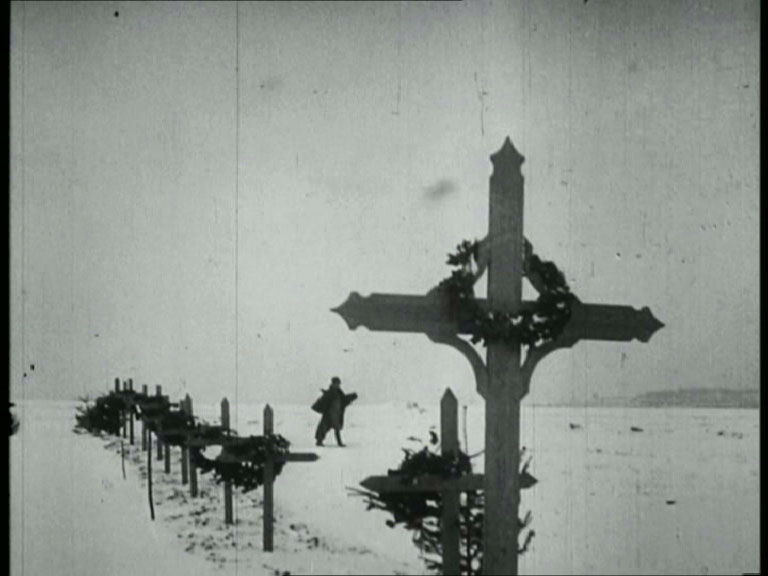
Saturday, February 11, 2012

The Front Among Rocks and Ice - The Great War in the Dolomites, part one.

The Front Among Rocks and Ice - The Great War in the Dolomites, part one.

"The front among rocks and ice" were the words of the war veteran Gunther Langes. In my opinion this is the best brief description of the war in the Dolomites - a lonely frontline, not so famous as the Western Front.

Certainly most of us have heard something about this front and the conditions there. But do we really know what the term "high altitude mountain war" means? The term "high altitude" is not an exaggeration here - it was a mountain warfare at the elevation of 3000 meters over the sea level, or higher. 

And no one has planned it at the beginning. The Italian plan was short and simple - to cross the mountain passes quickly, advance to the valleys and march towards Vienna. This was the plan, but the reality was much different...

There is nothing better than photos, to show the specific of the Italian Front. I hope that those pictures would help you to understand the extreme conditions of the war in the Dolomites. The photos were found in the internet and I added some explanations there, based on some books and articles of the Italian front.


The famous group of mountains called Drei Zinnen / Tre Cine di Lavaredo (2.999m)
Position 1 - Italian searchlight, position 2,3 - Italian cannon.

Trofana III (3.237m), Trofana II (3.243m) 
Position 1 - six Italian cannons and two searchlights.


Trofana I (3.225m)
Position 1 - tunnel, at the end of it the charge of 35.000kg of the explosives; position 2 - "August", Italian post and the way to it; position 3 - "Scudo", Italian post with machine gun and snipers, the way is the rope ladder; position 4 - Italian post at 2.900m, machine gun and mortar, the way to that post.
At the top of Trofana I - two Italian cannons and a searchlight.

Trofana I, general view.
Position 2 - Forcella di Rozes, an Austro-Hungarian post. Almost all Italian positions at Trofana were higher than the Austro-Hungarian ones.


Kleiner Lagazuoi (2.756m)
Position 1 - the debris made by Austro-Hungarian mine, 23.000kg of the explosives, 14.1.1917; position 2 - the debris made by Italian mine, 33.000kg of the explosives, 20.6.1917; position 3 - to place the Italian mine, a 1100m long tunnel was made.

Sasso di Stria,(2.477m)
This was a fortified Austro-Hungarian post, unfortunately there was no safe way to get there. As the casualties of the supply-carriers were higher than the casualties in the fight, a special tunnel was made for the purpose of supplying the positions.


To be continued...

(JD)

Sunday, February 5, 2012

The war graves - part two.


The war graves - part two.

In the previous post I’ve mentioned some graves in memoriam – the symbolic graves, erected for the soldiers who were buried far away from their homes, mostly at the battlefields thorough the Europe and Asia. 


This is one of them, dedicated to the soldier whose grave is in Nabrezina, Italy.


Certainly there were thousands of such soldiers and one can find a single grave in memoriam almost everywhere. But there is a special memorial that can be found at Prague municipal cemetery, called „hroby v dáli“ (the faraway graves). This is a symbolic grave dedicated to the citizens of Prague who died at many battlefields of the Great War and were buried there. 


The faraway graves - main board with a special prayer. 


Prague WW1 war cemetery with "The faraway graves" on the cemetery wall (in the background).


The names of dozens battlefields or cemeteries could be found there: Tarnow (Poland), Bitloje (Serbia), Pietra Rossa (Italy), Rybno (Galicia, now Ukraine), Gorica (Slovenia)…


General view of the WW1 cemetery. 


There is another interesting symbolic grave nearby. Erected in 1936 in memoriam of Czech seamen in the Austro-Hungarian fleet.

This is the end of our walk through Olšany Cemetery, so there is the last photo from there -        a grave of another soldier from the Great War, with his portrait on the tomb. What rivets our attention is a kind of a poem dedicated to this young soldier:


Dear son and young hero,
Being in warmth memory of all, you have gone far away
You have been heavily wounded on the field of glory and honor, and after the nine months of suffering
You’ve given your young life to the altar of your homeland

Your country was calling you! Believing in your duty
Young and loved by everyone, you have sacrificed your young life
Our memories drizzle on your grave with warmth tears
You’re dead but still alive in our hearts, and the hearts of all that knew you

I hope my translation of it is good enough and I hope you've enjoyed this short walk. Maybe those photos inspired you to visit your local cemetery? The graves from the Great War are almost everywhere and they shouldn't be forgotten.  


(JD)

Tuesday, January 17, 2012

The war graves - part one.


The war graves (1)

Ypres Salient, Flanders, the Somme Battlefields, the Battle of Gorlice…


The cemeteries at those places are widely known ones, as well as many other big cemeteries from the Great War. We know them; we can read about them in newspapers, books, and internet. 


But I do not want to tell you about those war graves today. I’d like you to think about your nearest neighborhood and the graves that are most probably forgotten. 


This is just a short walk around the biggest cemetery in Prague, Czech Republic - Olšany Cemetery, established in 1680. The cemetery is really huge, consisting of 12 sectors and with the area of more than 50ha. Over two million people were buried there…


Let’s start our journey to the past, looking for the graves of the Great War.


Vaclav Simanovsky - the grave of the WW1 soldier who died at age of 19 on the Italian Front. The portrait of this young man in the uniform is still there. 


Vladimir Lepar – lieutenant, field pilot of Austro-Hungarian forces, died in 1916. The exact date and the place of the death are unknown.


Rotter family – the grave in memoriam of two WW1 soldiers, Josef and Emil, who were buried abroad, probably near the battlefield in 1918 and 1917.
Frantisek Janos (the relative of them?) was on the Italian front and Balkan front during the Great War. He survived the war and died in 1971 as lieutenant-colonel.


Vladimir Spott -  ...heavily wounded during the combat at San and Vistula rivers 25.5.1915 / died in Brno 10.6.1915 / 28 years old


Those ones were just some samples, found during one short walk. There are dozens of such graves there – and if you’re interested in the story they’re telling – I can add more in the future.

I’m sure you’ve noticed that one grave was only in memoriam ones, the soldiers were buried far away from there, at the battlefield. There was no possibility for most of the people to visit the graves at the front line, even if the war was over. Many of such in memoriam graves could be found at the cemeteries around. This is one example I’ve found at the cemetery in small village of Chlum.


Ota Skalicky was a legionnaire of Czech Legion in Russia, he was buried at the cemetery in Omsk, Sibiria - almost 4000km from his village...


Is there an old cemetery somewhere around your place? If so, there is a possibility you may find some graves from the Great War there. They are hidden between the other ones and mostly not so easy to spot. But they are really worth not to be forgotten.

If you find any interesting graves please do not forget to share it at our Facebook fan page.
(JD)

Saturday, January 7, 2012

Book review - Walter Karjus – The Red Baron, Manfred von Richtofen


Walter Karjus –  The Red Baron, Manfred von Richtofen


This is a short book, with 100 pages only – but in my opinion the best book about Manfred von Richthofen I have ever read.
The book has eight chapters, each one is a short single story:

- The triplane: the story about the 80th Richthofen’s victory. This is all what most people know about the WW1 in the air. The red triplane, a famous pilot in the cockpit and hopeless British (or French) pilots who cannot escape their fate. The stereotype in its pure shape. A very good introduction to the story about this legendary pilot. 
The second part of this chapter is more serious, telling us about the Dreidecker, how it was created and used in combat. With some words about Richthofen added.

- Jasta: the story of WW1 aviation in brief – from the very beginning, then the first duels, looking for the perfect fighter plane idea, the troubles with synchronizer, the change from 1-to-1 duels to formations of dozens of aircrafts. The reason why German Jastas were created. This story ends with the Boelcke’s dead.

- Ritter Manfred von Richthofen: The one and only, unique and legendary. Why? What makes Richtofen an iconic symbol of the Great War? Author is trying to answer all such questions and in my opinion he is doing it right. The story ends in the moment Richtofen became the commander of the very first Jagdgeschwader.

- A lone warrior, Werner Voss: a short break in the main story, but also very interesting. There were many other aces among German pilots, but the author decided to tell us about Voss. It was a very good choice and the moment was perfectly chosen – remember that the previous capitol ends with the creation of Jagdgeschwaders. Voss was a lone warrior, a perfect fighter but without the traits of a leader. „Only the whitebeard or philosopher can afford to be a loner. Voss wasn’t a philosopher, so that’s why he didn’t become a whitebeard“. The era of lone fighters in the sky has gone away and Voss has gone away in the same time. 

- Anatomy of the fight: each and every fighter has his own tactics and dogfight technics. Here are some of them: Mc’Cudden, Ball, Guynemer… 

- The Flying Circus: the period from June 1917 to April 1918. All those frantic battles in the sky, but told with the background details. 

- I’ll tell you how the Red Baron died: 21st April 1918 hour by hour. The Requiem. 

- Pour le Merite: a kind of psychological study on the pilots, their behavior, traits and limitations. Many interesting details from their life and service.

At the end there are two appendices: a list of Richthofen’s air victories and the detailed study on his planes. Camouflage, marking, what was red and when. Really a perfect work.

The book is really interesting, written in the way one reads it with pleasure. The language used in it is very specific, full of irony and sometimes sarcasm. The author mentions many myths from the era and is proving them wrong in the ironical way. There is no pathos, we can see that the pilots were ordinary men, with their strengths and disadvantages, and many times with their kinks.

A short example of the style it is written:

„11th Squadron was in the permanent status of rearmament. The pilots didn’t manage to get familiar with their nice Sopwith Pups, when new child of wonder from Thomas Sopwith factory has arrived, the already known Triplane. However Brown has preferred Pup. I know this sounds as a shocking, maybe even infantile statement, but this was the custom in those days. The squadrons seemed to be a piece of Byzantine craftsmanship mosaic. Someone wants to fly Nieuport, Brown preferred Pup, someone else preferred Triplane. Let’s imagine today the pilot who wants to fly F-16 instead of MiGs received by his squadron.“
 
And last but not least – there is a riddle. Who is the author of this book? Walther Karjus* as written on the cover? Or someone else? 

Karjus couldn’t write the second part of the book, for sure. Especially the last chapter which was written by the contemporary author for sure. The owner of the copyright is Witold Chrzanowski, probably the Polish historian by that name. The only problem is that Chrzanowski had written many books but all of them are about the early times: ancient Rome and Slavic history. 

Is Chrzanowski just an editor of the material somehow left by Karjus? But there is no „translated from …“ description in the book. Probably this is a book written by Chrzanowski who didn’t want to give himself a bad name by publishing a story from the Great War, especially written with a sense of humor.

Karjus was a pilot in Jasta 11 and Jasta 75. He was a valiant observer who had been badly wounded and had lost his right arm. Fitted with a prosthetic device he became a pilot and then flying instructor. One confirmed air victory on 21 October 1918.

(JD)

Friday, January 6, 2012

Book review - Terence Zuber, The Real German War Plan


Terence Zuber, The Real German War Plan 1904-14


Terence Zuber is something of a controversial figure regarding WW1 and the Schlieffen Plan.

He makes a series of bold statements concerning the plan (or lack of) and criticises several historians such as Holger Herwig and Anniker Mombauer.

Schlieffen as Chief of the General Staff in 1904-1905 played 3 separate war games and the battles took place in German or Belgian territory and there is no evidence Schlieffen played an outright offensive against France or Russia.

The 'classic' Schlieffen plan actually has written on it that it was intended for a one front war against France only! Even for this he calls for 96 divisions, 24 more than Germany actually had.

Schlieffen's planning over his tenure appeared to be to use Germany's interior position to mass against troops on one front and then use superior tactics to achieve a victory. Of course, this could not continue for ever.

There is nothing in the literature to suggest that the campaign in the west would be concluded in 6 weeks.

The map everyone knows is a combination of the Schlieffen plan map of 1905 and the events of 1914. The 1st army was intended to act as a flank guard and not to march around Paris. Furthermore, Schlieffen felt the Germans would be halted on the Oise and the Aisne.
(ES)

Thursday, January 5, 2012

Movie review - Flyboys by Tony Bill (2006)


Flyboys by Tony Bill (2006)

I was thinking about this review for the long time because I wasn’t sure what to write… If I could describe it with just one line, the result would be – a complete disaster, one of the worst WW1 movies I’ve ever seen.

The movie had two main plots – one is the story of the Lafayette Escadrille in France, the second on is the romantic plot telling us the love story in the war time. Well, I think I’m not enough familiar with movie love stories to write the review about the second plot, so this review would be focused on Lafayette Escadrille only.

The budget of this movie was 60.000.000 USD (compare to 18.000.000 USD spent on Red Baron in 2008) and in the result we’ve received a movie that is telling us everything but not the reality of the Great War. I really do not understand why this is a problem to hire someone with average knowledge of WW1 aviation and reality? Just the average, we’re not expecting the miracles…

I have the conclusion that the director and screenplay writer had confused the Great War with WW2. The German fighter plane attacking the column of French war refugees… the bomb raid over Paris, with close escort of fighters… all this looks like the scenes of the WW2 but just the old equipment. And again, the sky is full of Dreideckers as the only German plane. Maybe it looks great in the movie, but in the real world only ca. 320 of them were built (compare to 1700 Fokkers D.VII or 2500 Albatroses D.V). The aerobatics shown in the movie is great, but no WW1 plane could stand it. 


The sky is full of all-red Fokker Dreideckers...

The list of factual and other mistakes is very long, but just some examples: there were no Zeppelin air raids with close escort of dozens of fighters, there were no Zeppelin raids on Paris, the range of WW1 fighter was not enough to fly from the front line to Paris and back for the escort purposes, there were no Dreideckers in 1916, the marking and cammo of the plane is wrong… Enough?

Some of the scenes are really with no common sense, as the example the one when Blaine takes off after rescuing Lucienne, he killed the German soldier firing at him and kneeling. Could anyone explain how the machine gun mounted over the engine of the taking off plane is possible to fire at the man kneeling in front of it? 


 The Great War or Star Wars?

The characters in the movie are fictional; however the producers have claimed they were based on real persons. It’s hard to believe in it as the characters shown are just flat stereotypes. Just take the planes away, move them from France to the Wild West and as the result you would have a „B“ class western story. Additionally this movie is full of social clichés and sometimes I had the feeling that the romantic story is the main one and the war is only the background. And it’s really too long, not exciting at all. 


Is there a war outside?

If you want to get to know anything about the WW1, Lafayette Escadrille and aviation – look for another movie. If you want to see a tragic love story with the war in the background – spend your time with „Gone with the Wind“.

Do not waste your time with „Flyboys“.

And as the final conclusion – the rotary engine is called „rotary“ because… yes, because it is rotating. How surprising, isn’t it?
(JD)

Tuesday, December 13, 2011

Christmas Truce - reality or just a myth?


The Christmas time is coming, so please check our Facebook fan page and the photoalbum related to the Christmas during the Great War. 

One of the most known tales from the Great War is the one regarding the Christmas Truce. Was the truce real? There are some interesting facts from Thomas Löwer's article.

The Christmas Truce happened in 1914. Bruce Bairnsfather, an English soldier has remembered that "The soldiers exchanged gifts, sometimes addresses, and drank together. The truce started with a request to bury the dead comrades lying between the trenches."


Many war diaries report a football match occurring during the 1914 truce, but whether or not a match was really played is unclear. Historians are still debating if a match was really played or if the soldiers just dramatized the truce. Contrary to in 1914, it is certain that a match between German and English soldiers occurred in 1915.


Armistice Day football match at Dale Barracks between german soldiers and Royal Welsh fusiliers to remember the famous Christmas Day truce between germany and Britain  

Alfred Anderson, the last known survivor of the 1914 “Christmas Truce” who died in 2005: “I remember the silence, the eerie sound of silence. But there was a dead silence that morning, right across the land as far as you could see. We shouted ‘Merry Christmas,’ even though nobody felt merry. The silence ended early in the afternoon and the killing started again"

There were no truces in following years, and 1914 truce was mystified as an act of humanity in an inhuman war. Jorgensen and Harrison-Lever published a picture book for children with the Christmas Truce as the background.

But the war went on and the thing has changed... A German officer wrote in his letter:  “...such a proposal in the past would have been accepted with pleasure, but at the present time, when we have clearly recognized England’s real character, we refuse to any such agreement. Also we do not doubt that you are men of honor, yet every feeling of ours revolts against any friendly intercourse towards the subjects of a nation which for years has, in underhand ways sought the friendship of all other nations, so that with their help annihilate us, a nation also which, while professing Christianity, is not ashamed to use dum-dum bullets; and whose greatest pleasure would be to see the political disappearance and social eclipse of Germany.[…] But all the same you are Englishmen, whose annihilate we consider as our most sacred duty. We therefore request you to take such action as will prevent your mercenaries, whom you call soldiers, from approaching our trenches in future.”

The same was at the other side of the trenches. Captain Billy Congreve from the 3rd division noticed that the Germans did try to make a truce for Christmas.

“We have issued strict orders to the men not to on any account allow a truce, as we have heard rumours that they will probably try to. The Germans did. They came over towards us singing. So we opened rapid fire on them, which is the only truce they deserve.”

That this example of humanity did not occur again has several reasons. One was definitely the change in warfare. Poison gas was used in 1915 for the first time and British cities were bombed by German Zeppelins. Furthermore, the hatred for the German inhumanity increased with the sinking of the Lusitania by a German submarine. Moreover, the conventional warfare became crueler and the causalities on every side were much higher than in 1914.

Another reason was that the headquarters were better prepared and used precautionary measures to prevent a truce. The punishment was on both sides more or less the death penalty.


Western front, Christmas 1914

(JD)